



Pharmaceutical Sampling Booths: Applications and Selection Considerations

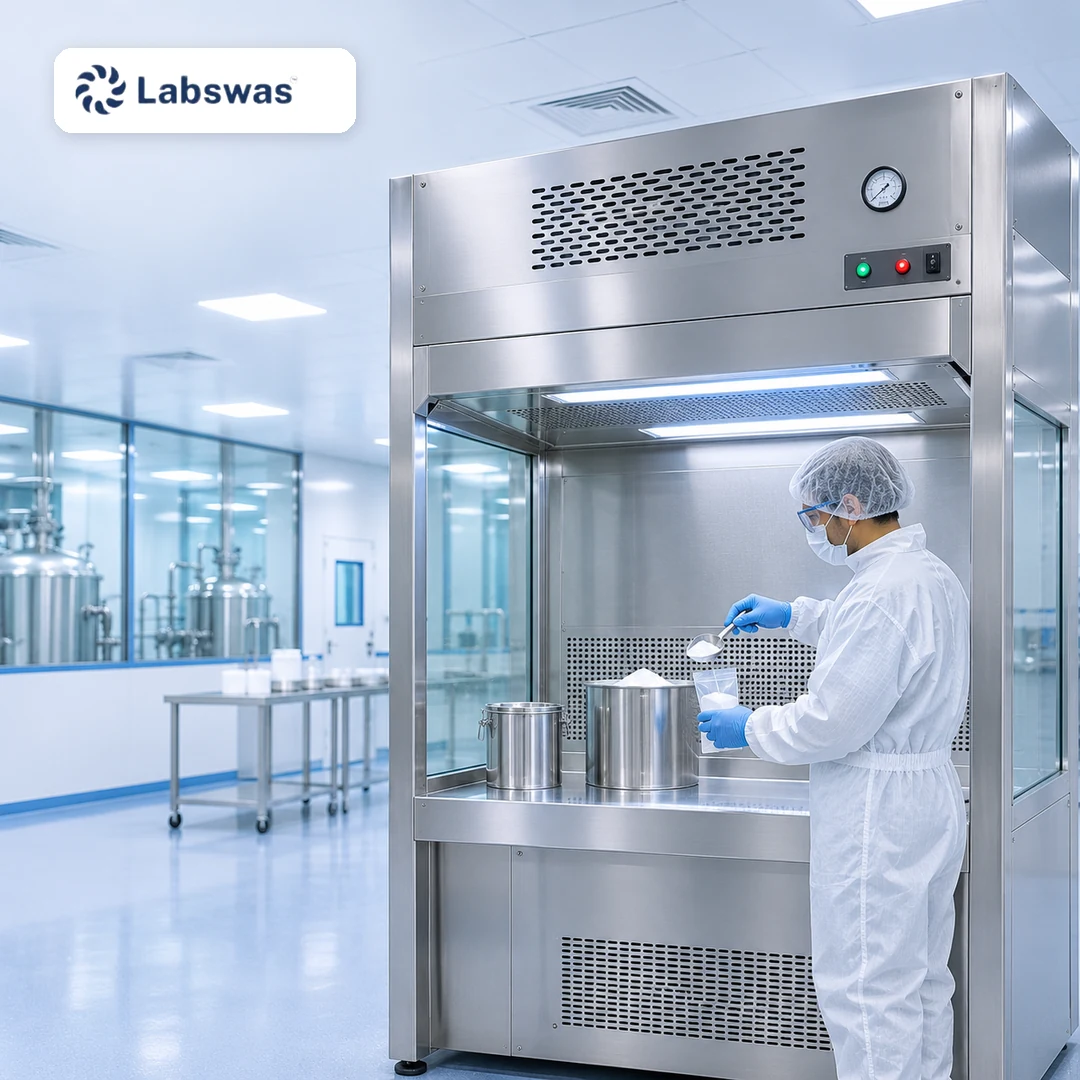
Handling pharmaceutical raw materials requires careful control over airborne particles, cross-contamination and operator exposure. Activities such as collecting samples, weighing powders and transferring ingredients can release fine particles into the surrounding environment. Without suitable controls, these particles may affect product quality, create workplace hazards and complicate cleanroom operations.
A pharmaceutical sampling booth provides a controlled workspace for these activities. It uses engineered airflow and filtration to help manage airborne contamination during material handling. Selecting the right booth requires an understanding of the process, material characteristics, airflow requirements and facility conditions.
What Is a Pharmaceutical Sampling Booth?
A pharmaceutical sampling booth is an enclosed or partially enclosed workstation designed for sampling, weighing and handling raw materials in controlled environments. It is commonly used in pharmaceutical manufacturing facilities, quality-control laboratories, API handling areas and material dispensing rooms.
Many systems use HEPA-filtered air and a controlled airflow arrangement to reduce airborne particle contamination. Depending on the design, air may be recirculated through filters or partially exhausted from the booth. A suitable pressure arrangement helps control the movement of airborne particles around the working area.
The equipment is also known as a cleanroom sampling booth, powder sampling booth or pharmaceutical dispensing booth, depending on its configuration and intended application.
Companies planning laboratory or cleanroom equipment installations can explore Labswas laboratory equipment solutions to understand the available equipment for pharmaceutical and industrial environments.
Where Are Sampling Booths Used in the Pharmaceutical Industry?
A sampling booth in pharma supports several material-handling operations where contamination control and operator protection are important.
1. Raw material sampling
Pharmaceutical manufacturers receive different raw materials before production. Representative samples must be collected for identification, quality testing and approval. A controlled booth helps manage airborne particles during sample collection and packaging.
2. API sampling and handling
Active pharmaceutical ingredients may have different exposure hazards depending on their properties and potency. A properly engineered booth can help contain airborne particles during handling. The containment requirement must be established through a material-specific risk assessment.
3. Powder weighing and dispensing
Powder dispensing booths provide a controlled workstation for weighing and measuring ingredients. They are useful when operators handle fine powders that could otherwise become airborne during transfer.
4. Quality-control and laboratory operations
Sampling booths can support laboratory teams when collecting samples from incoming materials, intermediates or other process materials. A properly selected system helps maintain cleaner working conditions and organized sampling procedures.
5. Pharmaceutical production support
Facilities may use sampling and dispensing booths in designated material-handling areas to support controlled transfer and weighing activities before manufacturing operations.
How Does a Pharmaceutical Sampling Booth Work?
A typical pharmaceutical sampling booth combines a supply-air filtration system, blower, working chamber and return or exhaust arrangement.
Filtered air enters the working zone through the supply filter system. The airflow pattern is designed to manage airborne particles generated during sampling or weighing. Air containing suspended particles is drawn toward designated return or exhaust filters, depending on the booth configuration.
Some designs use a negative-pressure arrangement to reduce the escape of airborne powder into surrounding areas. Other configurations use recirculated air with controlled exhaust. The correct design depends on material hazards, containment requirements and the facility’s HVAC arrangement.
Important components may include:
- HEPA filtration: Helps remove airborne particulate matter from the supplied or extracted air.
- Blower assembly: Maintains the airflow required for the intended operating condition.
- Stainless-steel construction: Provides durable, cleanable surfaces suitable for controlled environments.
- Transparent panels: Improve visibility while allowing operators to work inside the designated area.
- Differential-pressure gauges: Help monitor pressure differences across filters.
- Lighting and control panels: Support visibility and operational control during sampling activities.
A HEPA filter alone does not establish containment performance or guarantee sterility. Airflow, pressure relationships, filter integrity and operating procedures must work together.
Pharmaceutical Sampling Booth vs Pharmaceutical Dispensing Booth
The terms sampling booth and dispensing booth are sometimes used interchangeably because both can support powder handling in pharmaceutical facilities. However, their actual functions depend on the equipment configuration and process requirements.
| Comparison | Sampling booth | Dispensing booth |
|---|---|---|
| Primary activity | Collecting representative material samples | Weighing and dispensing production ingredients |
| Typical operation | Opening containers and collecting samples | Measuring, transferring and weighing powders |
| Main concern | Sample integrity and contamination control | Product, operator and surrounding-area protection |
| Configuration | Based on sampling requirements | Based on weighing and dispensing requirements |
A facility may use one multifunctional booth for both operations, but this should only be done when the working area, capacity, cleaning procedures and containment performance support both activities.
Important Sampling Booth Specifications to Check
Before purchasing a booth, prepare a user requirement specification (URS) describing the materials, operations and performance expected from the equipment.
Filtration system: Check the supply and exhaust filter arrangement, HEPA filter efficiency, pre-filtration stages and filter replacement access. Request filter certificates and a suitable integrity-testing arrangement.
Airflow performance: Confirm the airflow direction, air velocity, distribution and operating range. Ask for airflow visualization and performance testing under defined operating conditions.
Pressure arrangement: Determine whether the process requires a negative-pressure working zone, controlled exhaust or recirculated airflow. Confirm that the design is compatible with the room HVAC and pressure cascade.
Construction and finish: Stainless steel such as SS304 or SS316 may be considered depending on chemical compatibility, cleaning agents and the application. Check surface finish, joint design, internal corners and accessibility for cleaning.
Working dimensions: Specify the largest container, weighing equipment and materials that operators will handle. Ensure the chamber provides sufficient space without restricting airflow.
Controls and monitoring: Consider differential-pressure indicators, airflow monitoring, alarms, lighting and accessible control panels. Confirm which parameters can be monitored and recorded.
Maintenance and qualification: Request operating manuals, electrical drawings, filter documentation, maintenance schedules and support for installation and performance qualification.
These sampling booth specifications should be finalized according to the intended process rather than copied from a standard catalogue.
How to Choose the Right Sampling Booth Manufacturer
Selecting a reliable sampling booth manufacturer requires evaluating more than equipment dimensions and purchase price.
Start by discussing your material characteristics, sampling frequency, powder handling procedures and operator exposure concerns. The manufacturer should understand these requirements before recommending a recirculating, exhaust or customized configuration.
Review construction quality, filtration arrangements, airflow controls, maintenance accessibility and documentation. Ask for technical drawings and confirm how the equipment will connect with existing HVAC and electrical systems.
Learn more about Labswas and its cleanroom equipment solutions. You can also review its client information and additional technical information in the Labswas equipment blog.
For application-specific requirements, explore the Labswas sampling booth solutions, including customizable configurations for pharmaceutical and other controlled environments.
Frequently Asked Questions
1. What is the main purpose of a pharmaceutical sampling booth?
A pharmaceutical sampling booth provides a controlled workspace for collecting and handling raw material samples. Its filtration and airflow arrangement helps manage airborne particles and supports contamination-control procedures.
2. Is a sampling booth the same as a powder dispensing booth?
Not necessarily. Both may use similar filtration and airflow technology, but sampling focuses on collecting representative samples, while dispensing involves measuring and transferring ingredients. Some systems are designed for both applications.
3. Which filter is used in a pharmaceutical sampling booth?
HEPA filters are commonly used to control airborne particulate matter. The required filter grade, arrangement and integrity-testing method should be determined from the process and applicable performance requirements.
4. Why is negative pressure important in a sampling booth?
A suitable negative-pressure arrangement can help prevent airborne powder from escaping into the surrounding room. The actual pressure differential and airflow direction must be established through a process-specific containment assessment.
5. What materials are used to manufacture sampling booths?
Stainless steel, including SS304 and SS316, is commonly considered for cleanable equipment construction. Tempered glass or suitable transparent panels may also be used to improve visibility.
6. What should I check before purchasing a pharmaceutical sampling booth?
Check the filtration system, airflow performance, pressure arrangement, construction material, working dimensions, control system, maintenance access and qualification documentation. Make sure the proposed design suits the materials and sampling process.
Choose a Sampling Solution Around Your Process
A pharmaceutical sampling booth should be selected according to material characteristics, operator safety, contamination-control requirements and facility conditions. Proper planning helps ensure that the equipment supports routine sampling and dispensing activities without creating unnecessary operational or maintenance challenges.
Discuss your application, required dimensions and technical specifications with an experienced equipment supplier before finalizing the design. For customized pharmaceutical sampling booth requirements, contact Labswas to discuss a suitable configuration for your facility.