



Dynamic vs Static Pass Box: Which Is Right for Your Cleanroom?

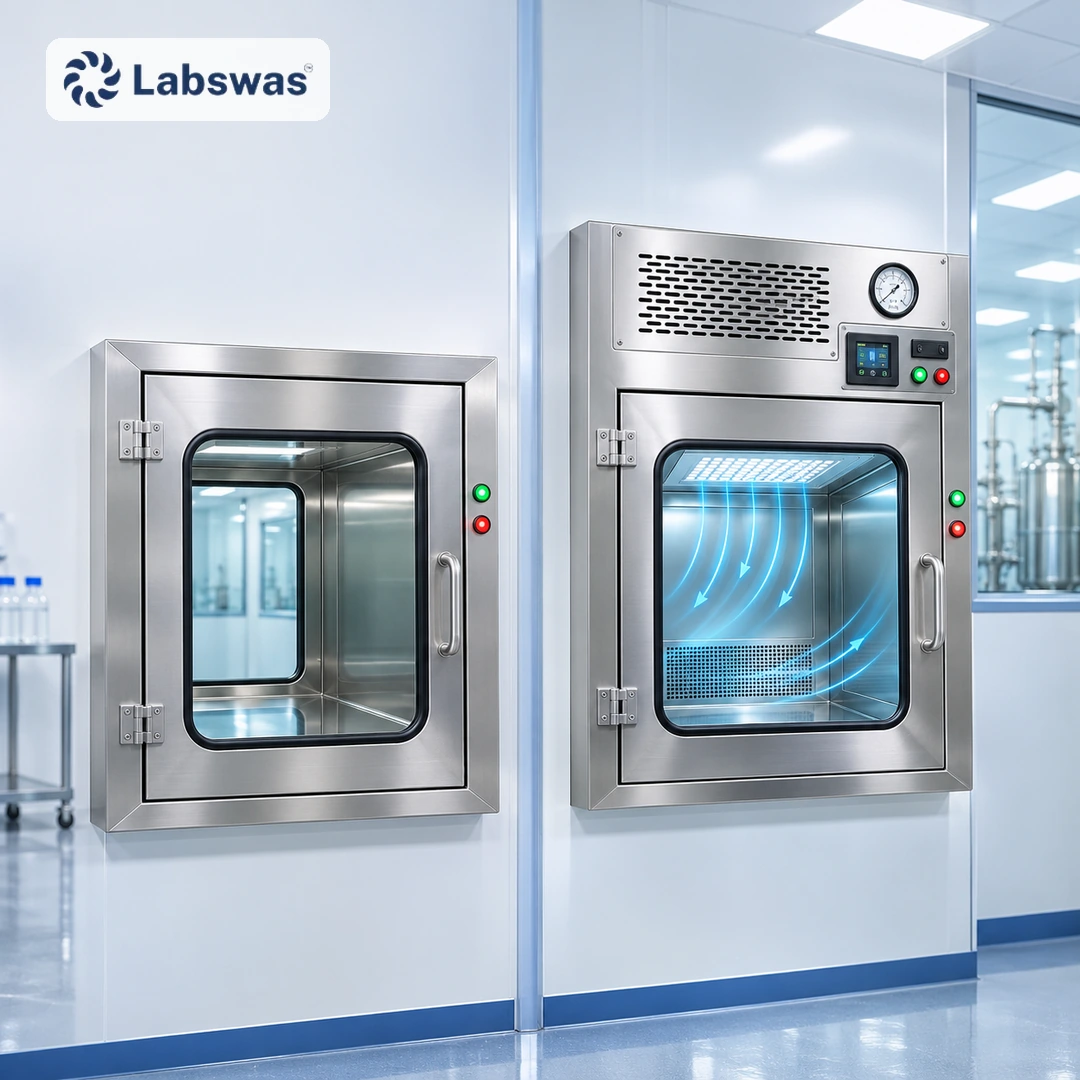
A pass box moves materials between controlled rooms without repeatedly opening personnel doors. The choice between a dynamic pass box and a static pass box depends on the transfer risk, room classifications and contamination-control strategy. A static unit uses an enclosed chamber and interlocked doors; a dynamic unit adds powered, filtered airflow to help control airborne particles.
For pharmaceutical, biotechnology and laboratory facilities, define the requirement during cleanroom design or equipment specification—not after installation.
What Is a Cleanroom Pass Box?
A cleanroom pass box is an enclosed chamber installed in a wall or partition between two areas. A door on each side is connected to a mechanical or electrical interlock that prevents both doors from opening at once. This reduces direct air exchange and limits movement through main personnel doors when transferring tools, components, samples or packaging.
A pass box supports controlled transfer; it does not make an item sterile. Cleaning, disinfection or sterilization must follow procedures appropriate to the item and room classification. Explore the Labswas pass box range, company website and company background.
Static Pass Box: Simple, Controlled Transfer
A static pass box is a passive chamber. Its main controls are the enclosure, cleanable internal surfaces, door seals and interlocks. The operator loads the material, closes the first door, and then the receiving-side door can be released. A basic static design does not use a fan and HEPA filter to actively flush the chamber with filtered air.
It may suit lower-risk transfers where facility procedures and room controls already manage the condition of the materials. Static units are often considered for transfers between areas with compatible cleanliness requirements when active air cleaning inside the chamber is not required. Their simpler construction may reduce initial cost and servicing needs.
Performance depends on construction, interlocks, cleaning and operator practice. Similar room classifications alone do not prove suitability; assess the transfer route. See the Labswas static pass box for design options.
Dynamic Pass Box: Filtered Airflow During Transfer
A dynamic pass box includes a powered air-handling system. A fan moves air through a filtration arrangement—commonly a pre-filter and HEPA filter—and supplies filtered air into the chamber. Depending on the design, air follows a defined pattern and may return through grilles for recirculation. This helps reduce airborne particles in the chamber and protect the cleaner side during transfer.
The dynamic pass box working principle is straightforward: after loading, the operator closes the first door and the interlock secures the opposite door while the blower runs. The receiving-side door is released after the defined cycle. Designs may include PLC controls, differential-pressure indication, alarms and filter-test ports.
Consider a dynamic unit when materials move between areas with different cleanliness levels or when the risk assessment requires active filtered-air flushing. In pharmaceutical manufacturing, a dynamic pass box may form one part of a wider material-transfer control strategy. Filtered airflow does not replace wiping, disinfection, sterilization or validated transfer procedures, and it does not guarantee that every surface or wrapped item is decontaminated.
Dynamic vs Static Pass Box: Key Differences
| Selection factor | Static pass box | Dynamic pass box |
|---|---|---|
| Air system | No powered chamber filtration in the basic design | Fan and filtered-air system |
| Main control | Enclosure, seals and door interlocks | Interlocks plus filtered airflow |
| Typical use | Compatible controlled areas with lower transfer risk | Where active air flushing is required by risk assessment |
| Complexity | Comparatively simple | More components and control logic |
| Maintenance | Chamber, seals, hinges and interlocks | Static checks plus fan, filters and airflow controls |
| Cost | Usually lower equipment complexity | Usually higher initial and lifecycle costs |
Neither option is automatically suitable for every cleanroom grade. A dynamic model is not a shortcut to aseptic transfer, and a static model is not inherently unsuitable for all pharmaceutical applications. The facility must define the transfer conditions and demonstrate that the selected setup controls the identified risks.
How to Choose the Right Pass Box
Map the material route first: room classifications, pressure relationship, transfer direction and whether items enter a high-grade or critical area. Identify the risk to control, such as airborne particles, contaminated packaging or microbial transfer.
Document the load dimensions, weight, packaging and transfer frequency. These determine chamber size, door opening and installation height. Specify smooth, corrosion-resistant surfaces, with SS304 or SS316 selected for process and cleaning-agent compatibility.
Involve quality, engineering, HVAC and operations before ordering. Confirm pressure-cascade compatibility, cleaning method, interlock behaviour during power failure, alarms and records. Define qualification and monitoring needs in advance, and request drawings, filter documents, test access and installation support.
Dynamic Pass Box Specifications to Confirm
Dynamic pass box specifications vary by design. Put required performance in the user requirement specification (URS), rather than relying on a generic brochure. Confirm:
- Filtration and airflow: Filter class and efficiency, filter arrangement, airflow pattern, flushing cycle and filter-integrity test method.
- Pressure and monitoring: Design airflow and pressure, differential-pressure gauge range, alarm setpoints and operating mode.
- Interlocks and controls: PLC logic, door indicators, cycle timing, alarms and response during power failure.
- Construction: Chamber dimensions, stainless-steel grade, surface finish, glass, seals, mounting flange and utility connections.
- Qualification support: Drawings, wiring diagrams, manuals, filter certificates, test ports and support for airflow, filter-integrity and particle-count testing.
The Indian Pharmaceutical Association’s Guidance on Good Engineering Practices describes one dynamic pass box arrangement with an H14 final HEPA filter, PLC control, filter differential-pressure gauge, electromechanical door locking and a PAO test port. It also identifies air-change, filter-integrity and particle-count testing as validation considerations. These are useful supplier-inquiry points, not universal specifications; the URS and applicable requirements should determine the final design.
When evaluating a pass box manufacturer, request a clause-by-clause response to the URS instead of relying on a broad “GMP compliant” statement. Review the supplier’s experience, documentation, testing capability and service support. You can check Labswas client information and its cleanroom equipment blog during supplier evaluation.
Include room grades, pressure details, transfer direction, item list, dimensions, filtration, controls and qualification documents in the inquiry. Share the URS with the Labswas team for a technical proposal.
Frequently Asked Questions
1. What is the main difference between a dynamic pass box and a static pass box?
A static unit relies on its enclosure and interlocked doors; a dynamic unit adds a fan and filtered air. Choose according to room classifications, materials and transfer risk.
2. Is a dynamic pass box always required in the pharmaceutical industry?
No. Selection depends on room grades and risk assessment. Filtration does not replace validated cleaning, disinfection or sterilization.
3. Does a dynamic pass box sterilize materials inside it?
No. HEPA filtration treats air, not the item itself. Follow the approved cleaning or decontamination procedure for materials.
4. Which filter should be specified for a dynamic pass box?
Choose filter grade and efficiency according to performance needs and qualification. H14 appears in some engineering guidance but is not automatically required for every installation; confirm test documentation with the project team.
5. What should I ask a pass box manufacturer before ordering?
Share room grades, pressure relationships, load dimensions, construction, filtration and control needs. Request drawings, filter certificates, test provisions, qualification and maintenance details.
6. Can a static pass box be converted into a dynamic pass box?
Possibly, but space, electrical supply, airflow return, pressure balance, filter access and interlocks need engineering review. Replacement may be more practical.
Make the Selection Around the Transfer Process
Choose a pass box that meets the contamination-control requirement and can be operated, maintained and qualified consistently. Define the URS first, then compare static and dynamic designs against it.